KINEXON Sports App Guide: Phase Index Widget
The Phase Index Widget is a powerful new feature in the KINEXON Sports App that provides coaches with deep insights into training drills. By displaying the normative range of key performance metrics for different drill types, it helps coaches understand typical versus high-end workload demands, compare phases across single sessions (POST) and historical data (DEVELOP), and design training sessions that optimize player development while preventing overtraining.

Why Use the Phase Index Widget?
Key Benefits for Coaches
- Plan Efficiently – Build data-informed practice scripts with the right workload balance.
- Compare Demands – See how different drills compare in workload and intensity.
- Track Progress – Identify trends over time to adjust training strategies.
- Filter & Customize – In DEVELOP, set a minimum phase duration to refine your analysis.
- Export Data Easily – Save individual tables or export global data for deeper review.
Understanding the Widget Layout
The Phase Index Widget is a table-based visualization that categorizes training phases and displays:
- Phase Type – What type of drill it is (e.g., Warm-up, Sprint, Small-Sided Game).
- Metrics Normative Range – The typical and high-end values for selected performance metrics.
- Record Count – The sample size (Example: If a Warm-up drill had 20 players, the record value is 20. If two Warm-up phases occurred with 20 players each, the record is 40).
Example views:
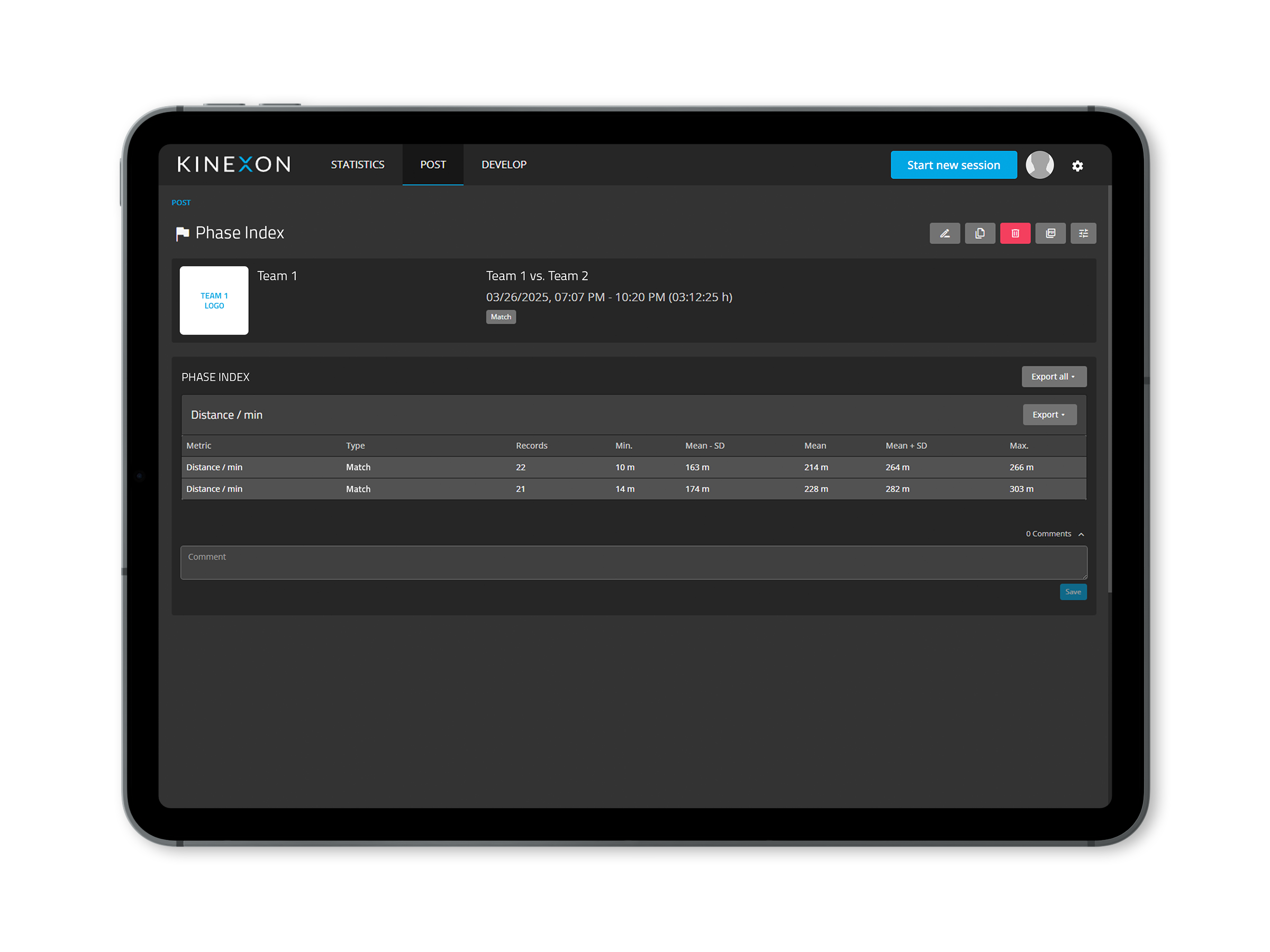
POST Widget (Single Session Analysis) – Breakdown of drills within a session.
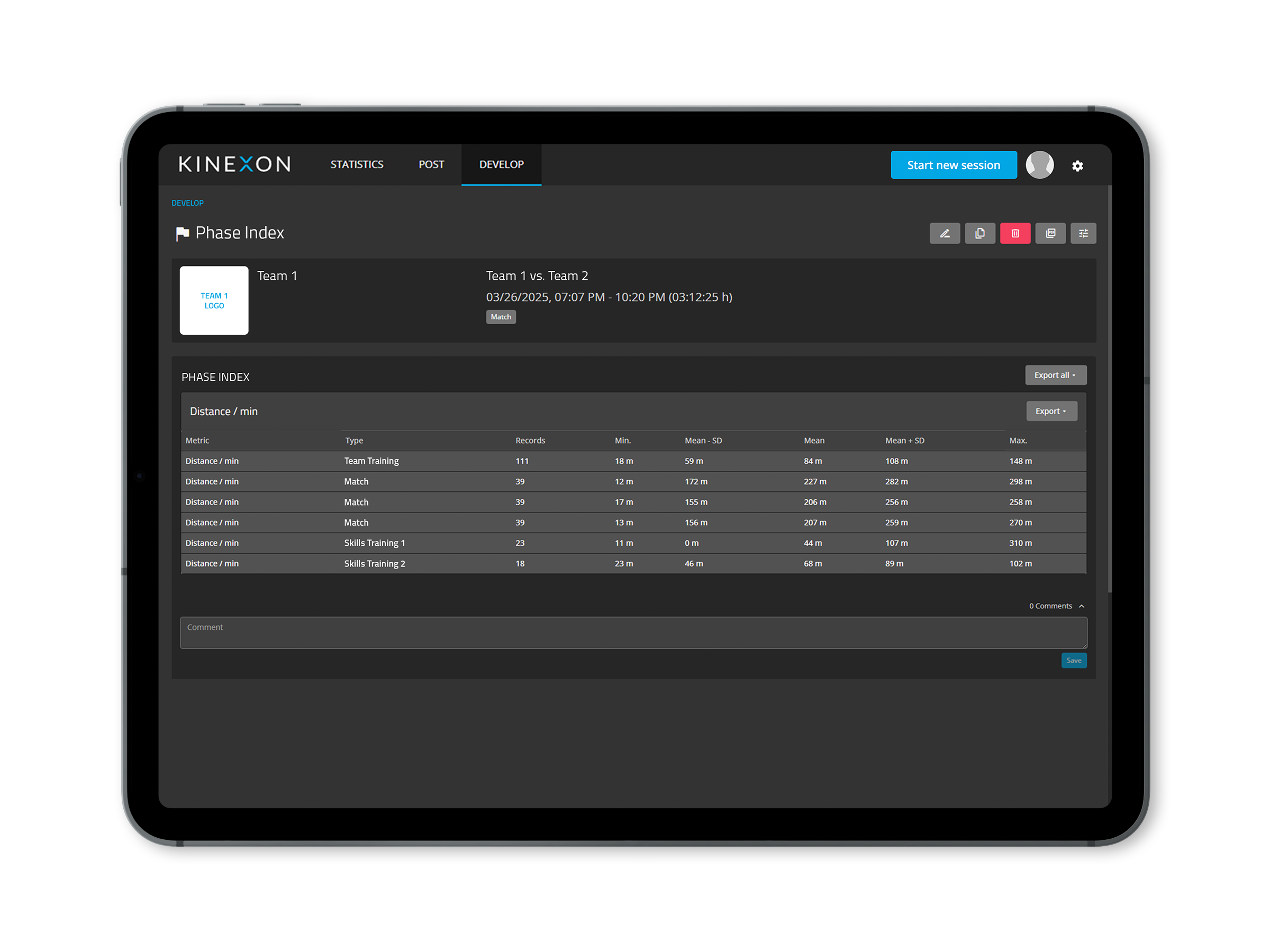
DEVELOP Widget (Long-Term Analysis) – Same logic, but includes a minimum phase duration filter.
How to Use the Phase Index Widget
Step 1: Ensure Phase Types Are Defined
- Assign phase types to all training drills in KINEXON Sports App.
- Use phase types to represent specific drills rather than generic groupings:
- Bad Example – Phase Type: Drill, Phase Description: 3 on 2
- Good Example – Phase Type: 3 on 2, Phase Description: Day after game vs. opponent A.
- Increased granularity of phase types will result in more specific insights from the Drill Index.
Step 2: Open the Phase Index Widget
- Navigate to POST (single session) or DEVELOP (historical data).
- Select the Phase Index Widget from the widget options.
Step 3: Customize Widget Options (For DEVELOP Analysis)
- Set Minimum Phase Duration – Exclude short phases that are not representative of typical demands for that drill.
- Export Data – Save individual drill tables or all global data.
Step 4: Interpret Data & Adjust Training
- Identify Overloads: If a high-intensity drill exceeds benchmarks, reduce workload.
- Compare Drills: Find the most effective drills for your players’ goals.
- Refine Training Plans: Adjust workloads for optimal player performance.
Real-World Use Case
Scenario: Optimizing Small-Sided Games for Match Readiness
Objective: A soccer coach wants players to experience game-like workloads during training.
- Step 1: Check past Small-Sided Game drills in the Phase Index Widget.
- Step 2: Compare sprint distance per player to high-intensity game norms.
- Step 3: If training values are lower, increase drill duration or intensity.
- Step 4: Monitor in DEVELOP to track improvement over time.
Want More Coaching Insights?
Read our latest blog on data-informed coaching in 2025
The Phase Index Widget is your secret weapon for making training data-informed, efficient, and impactful. Whether analyzing a single session in POST or tracking long-term trends in DEVELOP, this feature provides actionable insights to optimize player readiness and fine-tune training strategies.
Try it now and level up your coaching!
More stories

How Basketball Performance Data Connects the Court and Weight Room
What happens on the court shapes what athletes need in the weight room. Purdue’s Jason Kabo shares how he cross-references KINEXON performance data with sprint testing and other measures to adjust training, manage individual workloads, and guide daily decisions.

From Jump Count to a More Complete View of Volleyball Load
Jump count is one of the most familiar metrics in volleyball, but it only captures part of an athlete’s physical performance. Looking at movement intensity, like acceleration or changes of direction, and position-specific demands can provide the context needed for a more complete view of the overall load.

Limited Camps, High Demands: Preparing for International Handball Tournaments
The Women’s EHF EURO and Men’s World Championship present a similar challenge for performance staff: preparing players for an intense tournament with limited time together. How can national teams use the camps leading into competition to better understand and manage individual load?

How Drill Intensity Shapes Weekly Basketball Load Targets
Basketball coaches need more than a list of practice drills. Historical performance data and drill intensity help coaches refine practice plans, manage individual workloads and adjust the next session based on what athletes actually completed.

Sustainability: Can the Athlete Maintain Intensity Throughout the Duration of the Game?
Matching game workloads are only part of athlete preparation. Can players sustain high-intensity efforts when fatigue builds? Read more from Dayannara Munoz, KINEXON Sports Customer Success Manager, about how performance data helps coaches assess changes in output, compare practice with competition, and prepare athletes to meet the demands of the entire game.

How Individualized Football Performance Data Improves Load Management
Football performance data helps coaches move beyond team averages to individualize load management. By combining GPS metrics with each athlete’s role, historical data, and readiness, coaches can identify the right exposure, reduce excessive stress, guide recovery, and better prepare every player for game day.

Beyond the National Team Window: How the DHB Connects Performance Data
National teams spend only a fraction of the season with their athletes. See how the German Handball Federation connects club and national-team data to maintain performance context across the season and support individual decisions when players move between environments.

One Athlete, Two Jerseys: Connecting Athlete Monitoring Between Club and Country
When athletes move between club and country, their performance history moves with them. The 2026 FIBA Women’s Basketball World Cup highlights why monitoring continuity matters when athletes arrive with different workloads, competition exposure and preparation behind them.

The Role of Connected Ball Technology in Modern Officiating
From ghost goals to offsides, officiating technology has steadily raised fairness in football. But the one element at the center of every decision, the ball, has until now been silent. Connected Ball Technology (CBT) changes that, giving football’s most iconic object its own voice.

COMPETE Vision on a New Level: Refined for Faster Insights
The latest COMPETE Vision update streamlines the entire performance analysis workflow, from camera setup to automated reporting. Faster uploads, improved player identification, automated court calibration, and smarter player assignment help coaches spend less time managing technology and more time turning objective data into coaching decisions.

How KINEXON Game Insights Gives Basketball Coaches the Tactical Advantage
Basketball coaches already use in-game tracking data to evaluate their athlete’s physical exposure. As more teams adopt performance tracking methodologies, that same underlying data source can extend beyond physical optimization and be utilized to compare rosters, assess opponents, and understand the demands behind each matchup.

From Data to Decisions: Six Key Takeaways from Elite Handball Performance Practitioners
Elite handball is one of the most physically demanding team sports in the world. Within sixty minutes, players sprint, decelerate, jump, throw, change direction, absorb contact, and repeat those actions under fatigue, all while making split-second tactical decisions.

From Potential to Performance: How AI, Ball & Player Tracking Are Transforming Talent Identification in Youth Football
How can AI, player and ball tracking, and expert scouting work together to identify football talent? Discover how Skillers Academy, SAP, and KINEXON Sports combine connected technologies and human expertise to create a more objective and accessible approach to youth talent identification.

How Xavier Women’s Basketball Optimizes Daily Load Targets for Low- and High-Minute Players
Optimizing daily workloads goes beyond keeping players fresh. For Xavier’s Gil Weinstein, Head Strength and Conditioning Coach, daily (and weekly) performance reports helped connect practice loads to game demands, guide workload adjustments, and support 99% player availability throughout the 2025 – 26 season.

Inside Columbia Women’s Basketball’s Approach to In-Season Load Management
Managing in-season workloads takes more than tracking minutes. Performance data helps basketball coaches individualize weekly targets, adjust practice plans, and keep high-minute players, role players, and scout team athletes prepared to perform.