Why Ball Tracking Is So Important To Football Coaches, Referees, and Fans
Sports performance software is now benefiting referees. Football analytics are helping match officials make more accurate and consistent decisions. And the sports data it provides allows coaches to analyze the beautiful game with unprecedented detail and gives fans insights never seen before.

Did a player touch the ball? When did they touch it? Until recently, it was virtually impossible to give a clear and reliable answer to these questions. Today, ball tracking is revolutionizing how football (or soccer, how some of us say) matches can be called. And you don’t need a soccer ball tracking camera anymore.
Using Ultra Wide Band (UWB) and Inertial Measurement Unit (IMU) technology, connected ball technology can provide real-time data to match officials. This optimizes decision-making on the pitch by precisely capturing the sport’s data on every touch of the game. This exact detection of the kick point allows for faster and more accurate analysis of offside incidents and other in-game situations. It’s football analytics at its best.
Three Ways Coaches, Referees, and Fans Benefit From Connected Ball Technology
Soccer Ball Tracking Helps Referees Make Proper Calls
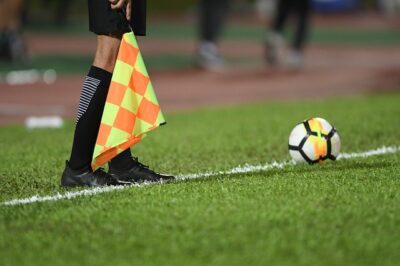
Additionally, using sports performance software, referees can see if a tackling player touched the ball (in real-time) and base their foul calls on reliable information rather than visual impressions. Thanks to three-dimensional tracking, connected ball technology can even help to detect if a player made contact with the ball with their hand and when.
The so-called heartbeat graphics clearly illustrate the moment the ball was touched. Hence, it is possible to determine whether a player had their foot on the ball before it crossed the goal line or whether the score should be awarded to their teammate.
„For the first time in the history of football, connected ball data will allow everyone involved to determine precisely when and if a ball contact has taken place.“
How Sports Perfomance Software and Ball Tracking Benefits Fans

Sports performance software captures every touch players make on the pitch and creates synergy with fans.
Official match balls with KINEXON’s ball tracking solution not only received the FIFA Quality Pro certification in February 2022, KINEXON also became the “FIFA Preferred Provider for Live Player & Ball Tracking.“ With the technology greenlit for official matches, the Liga Portugal Bwin later partnered with KINEXON and ball manufacturer SELECT to put together a test case.
During the first leg of Portugal’s relegation playoffs in May 2022, a league used an official match ball with a tracking sensor inside for the first time ever. Teams, broadcasters and social-media teams received hundreds of football analytics such as the ball’s rotation rate, shot speed, the tightest ball control, dribbling- and passing speed and accuracy, as well as successful tacklings in real-time. Sports analytics created a multi-dimensional view of the game everyone involved enjoyed.

Ball Tracking in Football: FAQs

So, how does sports analytics software make soccer ball tracking work? Why does the sensor not interfere with the ball’s flight characteristic? Which metrics can be gathered?
Read our ball tracking FAQs for further insights:
How does KINEXON’s ball tracking work?
KINEXON’s 500Hz IMU sensor can be integrated into any official match ball in corporation with ball manufacturers. Combined with the stationary real-time locating system by KINEXON (RTLS), it tracks the ball’s position up to 100 times per second with centimeter accuracy. Using artificial intelligence, the anchors around the pitch then transform the data into metrics such as speed, passing distance etc.
Does the sports analytics sensor interfere with the ball’s flight characteristics?
At only 7 g, the chip does not alter the ball’s physics. Hence, KINEXON’s xBall is the first sensorised ball with a perfectly balanced center of mass that does not interfere with flight characteristics. A crucial aspect for ball tracking to be suitable for in-game use.
How is the sensor charged?
Lightweight and low power, the sensor inside the tracking ball is charged wirelessly via a charging pad within 90 minutes. Once active, the battery life is up to 6h.
What are the benefits of the UWB and IMU technologies?
Combining UWB and IMU technologies, the connected ball technology transfers raw data in high resolution. UWB allows for precise tracking of the ball’s position, speed etc. At the same time, the IMU technology detects touches, rotation, force and movements. It is possible to pinpoint a touch down to 2 milliseconds. That way, it is possible to determine, for example, when the ball was played with millisecond accuracy.
Which advantages does the connected ball technology have compared to other tracking technologies?
Even from different angles, there may be several legs between a soccer ball tracking camera and the ball. With the sensor integrated into the ball, those disruptive factors drop out. Plus, a latency of only 20 ms means the human eye perceives everything ball tracking provides in real-time, which means: there is no faster and more reliable way to track the ball in real-time.
Do sensors work with any ball?
In theory, ball sensors from KINEXON can be integrated into every ball. In practice, KINEXON partners with leading ball manufacturers to equip ball models of professional leagues with the sensor. The reason: ensure that the ball tracking technology does not alter the ball’s rolling and flight characteristics or its weight and haptic sensation.
How does ball tracking support referees?
The connected ball technology tells in real-time when which player touched the ball and where, who changed its spin in which way, who passed or shot, and the ball’s position during any game moment. Hence, live-ball tracking helps match officials back up their decisions in real-time. Offside? Foul? Hand? Ball tracking helps detect every touch — or non-touch – and make a fair call.
Can soccer ball tracking data be combined with player tracking data?
Yes, KINEXON’s tracking engine not only enables live evaluation of sensor-based ball data but also the combination of sensor- and/or optical-based player tracking data. These can come from player tracking systems from KINEXON as well as from third-party providers. Thanks to open interfaces, KINEXON offers one of the most flexible and versatile solutions for tracking data analysis in professional sports.
How do coaches and players benefit from soccer ball tracking?
Sensor-based tracking of footballs (soccer balls) can provide valuable information to players, coaches, and fans alike. For players and coaches, sensor-based tracking can help them analyze their performance and make strategic decisions in real time. For example, sensors can track a number of football analytics, including the speed, spin, and trajectory of a football, which can help players and coaches understand how different kicking techniques affect the flight of the ball.
How does sensor-based soccer ball tracking benefit fans?
Sensor-based soccer ball tracking can enhance the viewing experience for fans. With real-time data on the movement of the ball, fans can get a better understanding of the game and see things that they might not be able to see with the naked eye, e.g. the ball’s spin rate.
If you’d like to learn more about KINEXON’S ball-tracking technology, don’t hesitate to contact us. We’d be happy to explain how it works and how it can help you make better coaching decisions.
More stories

How Position-Specific Volleyball Benchmarks Turn Performance Data into a Season-Long Plan
Position-specific performance benchmarks help volleyball coaches prepare athletes for competition and sustain performance throughout the season. With key performance metrics guiding insights for every athlete, coaches can gauge preseason progress, balance in-season volume and intensity, and support informed daily training decisions.

How Basketball Performance Data Connects the Court and Weight Room
What happens on the court shapes what athletes need in the weight room. Purdue’s Jason Kabo shares how he cross-references KINEXON performance data with sprint testing and other measures to adjust training, manage individual workloads, and guide daily decisions.

From Jump Count to a More Complete View of Volleyball Load
Jump count is one of the most familiar metrics in volleyball, but it only captures part of an athlete’s physical performance. Looking at movement intensity, like acceleration or changes of direction, and position-specific demands can provide the context needed for a more complete view of the overall load.

Limited Camps, High Demands: Preparing for International Handball Tournaments
The Women’s EHF EURO and Men’s World Championship present a similar challenge for performance staff: preparing players for an intense tournament with limited time together. How can national teams use the camps leading into competition to better understand and manage individual load?

How Drill Intensity Shapes Weekly Basketball Load Targets
Basketball coaches need more than a list of practice drills. Historical performance data and drill intensity help coaches refine practice plans, manage individual workloads and adjust the next session based on what athletes actually completed.

Sustainability: Can the Athlete Maintain Intensity Throughout the Duration of the Game?
Matching game workloads are only part of athlete preparation. Can players sustain high-intensity efforts when fatigue builds? Read more from Dayannara Munoz, KINEXON Sports Customer Success Manager, about how performance data helps coaches assess changes in output, compare practice with competition, and prepare athletes to meet the demands of the entire game.

How Individualized Football Performance Data Improves Load Management
Football performance data helps coaches move beyond team averages to individualize load management. By combining GPS metrics with each athlete’s role, historical data, and readiness, coaches can identify the right exposure, reduce excessive stress, guide recovery, and better prepare every player for game day.

Beyond the National Team Window: How the DHB Connects Performance Data
National teams spend only a fraction of the season with their athletes. See how the German Handball Federation connects club and national-team data to maintain performance context across the season and support individual decisions when players move between environments.

One Athlete, Two Jerseys: Connecting Athlete Monitoring Between Club and Country
When athletes move between club and country, their performance history moves with them. The 2026 FIBA Women’s Basketball World Cup highlights why monitoring continuity matters when athletes arrive with different workloads, competition exposure and preparation behind them.

The Role of Connected Ball Technology in Modern Officiating
From ghost goals to offsides, officiating technology has steadily raised fairness in football. But the one element at the center of every decision, the ball, has until now been silent. Connected Ball Technology (CBT) changes that, giving football’s most iconic object its own voice.

COMPETE Vision on a New Level: Refined for Faster Insights
The latest COMPETE Vision update streamlines the entire performance analysis workflow, from camera setup to automated reporting. Faster uploads, improved player identification, automated court calibration, and smarter player assignment help coaches spend less time managing technology and more time turning objective data into coaching decisions.

How KINEXON Game Insights Gives Basketball Coaches the Tactical Advantage
Basketball coaches already use in-game tracking data to evaluate their athlete’s physical exposure. As more teams adopt performance tracking methodologies, that same underlying data source can extend beyond physical optimization and be utilized to compare rosters, assess opponents, and understand the demands behind each matchup.

From Data to Decisions: Six Key Takeaways from Elite Handball Performance Practitioners
Elite handball is one of the most physically demanding team sports in the world. Within sixty minutes, players sprint, decelerate, jump, throw, change direction, absorb contact, and repeat those actions under fatigue, all while making split-second tactical decisions.

From Potential to Performance: How AI, Ball & Player Tracking Are Transforming Talent Identification in Youth Football
How can AI, player and ball tracking, and expert scouting work together to identify football talent? Discover how Skillers Academy, SAP, and KINEXON Sports combine connected technologies and human expertise to create a more objective and accessible approach to youth talent identification.

How Xavier Women’s Basketball Optimizes Daily Load Targets for Low- and High-Minute Players
Optimizing daily workloads goes beyond keeping players fresh. For Xavier’s Gil Weinstein, Head Strength and Conditioning Coach, daily (and weekly) performance reports helped connect practice loads to game demands, guide workload adjustments, and support 99% player availability throughout the 2025 – 26 season.